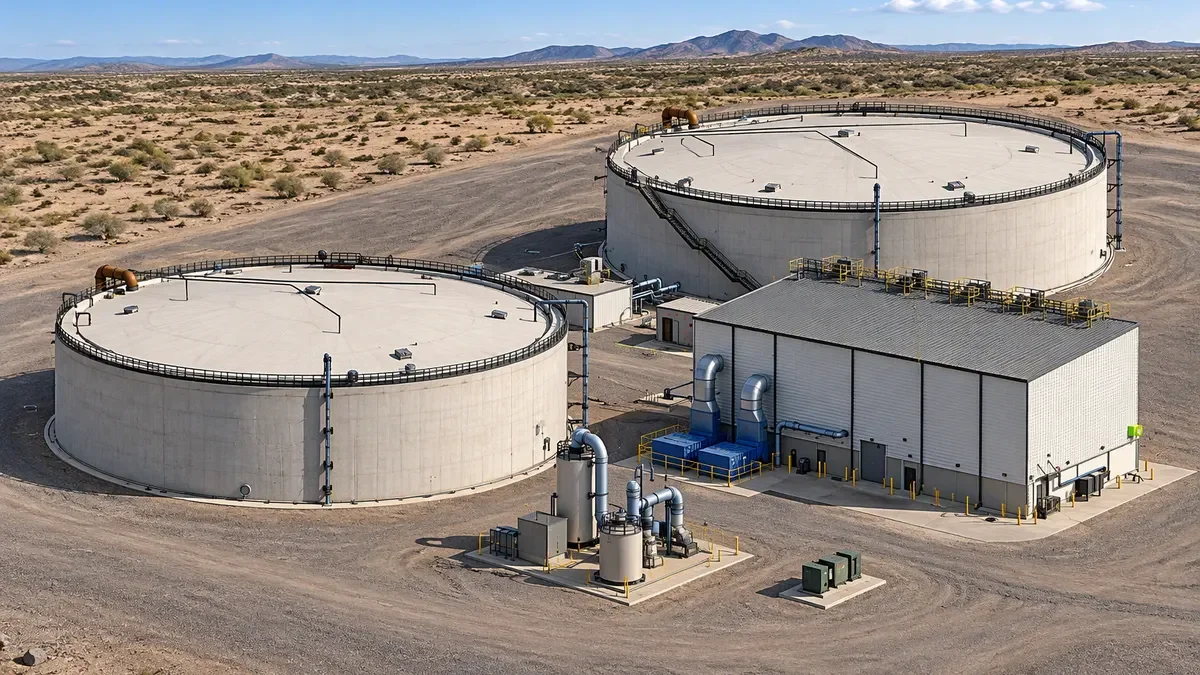
Ferrovial's Webber has landed a roughly $538 million contract to build the Mary's Creek Water Reclamation Facility in Fort Worth, Texas. It's the largest water infrastructure project Ferrovial has taken on in the U.S. so far, which tells you something about where the company wants its American water business to go. And it puts a new plant in the western part of the city, where the real consequences of this deal will play out.
What's going up
Webber, which is based in The Woodlands, will build the facility on a greenfield site. That's a meaningful detail. Building on open ground means the contractor doesn't have to work around a plant that's already running, which usually simplifies sequencing (it also means there's no existing operation to inherit, so every design choice starts from scratch).
The scope covers wastewater treatment, solids handling and odor control, along with electrical, instrumentation and control systems. Odor control gets less attention than it deserves. Anyone who has lived near a treatment works knows it can decide whether neighbors accept the plant at all.
When it starts running, the plant will process 10 million gallons of water a day. It will also produce reclaimed water for industrial and irrigation users, giving the city a second supply stream alongside its wastewater capacity. Treated effluent that gets reused is a different asset from effluent that simply gets discharged, and that distinction is what this project leans on.
Why reclaimed water matters more than it sounds
Reclaimed water is easy to overlook in a project announcement, because it sits as a secondary detail beside the headline capacity figure. Similar systems typically act as a buffer. Cities that reuse treated effluent can ease pressure on drinking-water sources when demand climbs, and industrial users often accept reclaimed supplies for cooling, process water and landscaping. The catch is that reuse only works if the water meets the quality a buyer needs, and that requirement is where projects like this either earn their keep or stall out.
Why the location matters
Peter Bailey, president of waterworks at Webber, sees strong demand ahead. He put the case in broad terms: "Population growth, industrial expansion and increasing pressure on existing water supplies are creating significant long-term infrastructure needs, particularly across the Southeastern U.S., where population growth projections point to continued demand over the next five to ten years," he told Construction Dive by email. Note that he's talking about the Southeast as a whole, not Fort Worth specifically, and that distinction is worth keeping straight.
Texas is already spending heavily to match that demand. Last year, both chambers of the state legislature passed bills to pump $20 billion into the sector. Dallas-Fort Worth now has two cities with more than 1 million residents each, the only metro in the country with that distinction, and Fort Worth ranks among the fastest-growing large cities in the U.S. according to the city's economic development partnership.
Here's the thing: state money doesn't automatically become a plant in a particular city. The source doesn't say how much of that $20 billion reaches this project, so don't draw a straight line from the legislation to Mary's Creek. What the funding does show is that water has climbed the state's priority list. That's the backdrop a project like this needs, even if it isn't the direct cause.
Plants like Mary's Creek tend to shape where development follows, and that's the part that rarely makes it into the press release. My read is that the reclaimed-water offtake will matter more for western Fort Worth than the raw capacity number, because industrial users need dependable water before they commit to a site. Think about it from a site selector's chair: 10 million gallons a day is an abstract figure, but a dependable reuse supply is something a facility planner can actually build around. That's why the reuse piece deserves more attention than the headline.
Webber's broader Texas pipeline
This isn't Webber's only water work in the state, and the other contracts tell a similar story. Last year, the company won a pump station contract in Austin and a treatment plant expansion in Fort Worth, together worth $721 million. Put those next to Mary's Creek and you're looking at a pattern rather than a one-off win. Patterns matter to contractors more than any single award, because repeat work with the same clients tends to shorten the next round of bidding.
What to watch from here
Construction is scheduled to begin this month and should wrap up by summer 2030. That's a long runway, and any timeline stretching that far deserves some healthy skepticism. Long runway, long memory, though: the plant is only part of the story.
Between now and then, watch whether the reclaimed water draws industrial tenants to the corridor. That's the outcome that would reshape the land around the plant. If it happens, the western side of the city could look noticeably different. If it doesn't, the facility still delivers wastewater capacity, just with a smaller economic footprint than its backers might hope for.
If you're tracking development in western Fort Worth, this is the signal to follow. Capacity figures are fixed on paper, but tenants aren't. If you're a builder or site developer, the reuse offtake is the variable to monitor. If you live nearby, the odor-control scope is the detail worth asking questions about. This is more significant than it looks, but the proof won't arrive until the plant is running and the first industrial users have actually signed on.