The George Washington Bridge’s South Walk has reopened after a major cable replacement and pathway rebuild, advancing the Port Authority of New York and New Jersey’s $2 billion restoration program. The milestone completes the eighth of 11 planned projects in an effort that began in 2013. For pedestrians, the change is immediate: a route that had been closed during construction is available again, with rebuilt approaches and a new viewing platform at the New York entrance. For the wider program, the reopening is a tangible sign of progress, though three planned projects remain.
A rebuilt crossing for pedestrians
Skanska completed the work under a $452 million contract to replace 592 suspender ropes. The project also rebuilt the 1.5-mile pedestrian route, widened its approach paths and improved connections to nearby streets. That combination matters: a bridge path is only as useful as the route people take to reach it, and narrow or difficult approaches can limit the value of improvements on the bridge itself.
The renovated approaches reach up to 14 feet wide, with slopes capped at 5%, according to the Port Authority. Those details describe a more generous walking space and a defined limit on the incline, both of which affect how comfortable and accessible a route feels in ordinary use. The figures don't, by themselves, establish how every visitor will experience the walk; conditions can vary along a route, and its connections beyond the bridge are part of the practical test.
A new viewing platform now sits at the New York entrance, while the New Jersey side has an expanded entry plaza. These additions give the crossing more room at its ends, where people arrive, pause and orient themselves before continuing. The platform also recognizes that the bridge serves as more than a way across the river: it offers a public vantage point. The experience begins before the main span.
The South Walk closed in February 2023 so crews could replace the ropes. During construction, pedestrians and cyclists shared the North Walk. The reopened South Walk is now dedicated to pedestrians, while cyclists have exclusive use of the North Walk. Separating the two groups should make each route easier to navigate, especially where people travel at different speeds. That said, the source doesn't describe operating rules or how the division will work during busy periods, so the benefit will be clearest in day-to-day use.
Construction staged around bridge traffic
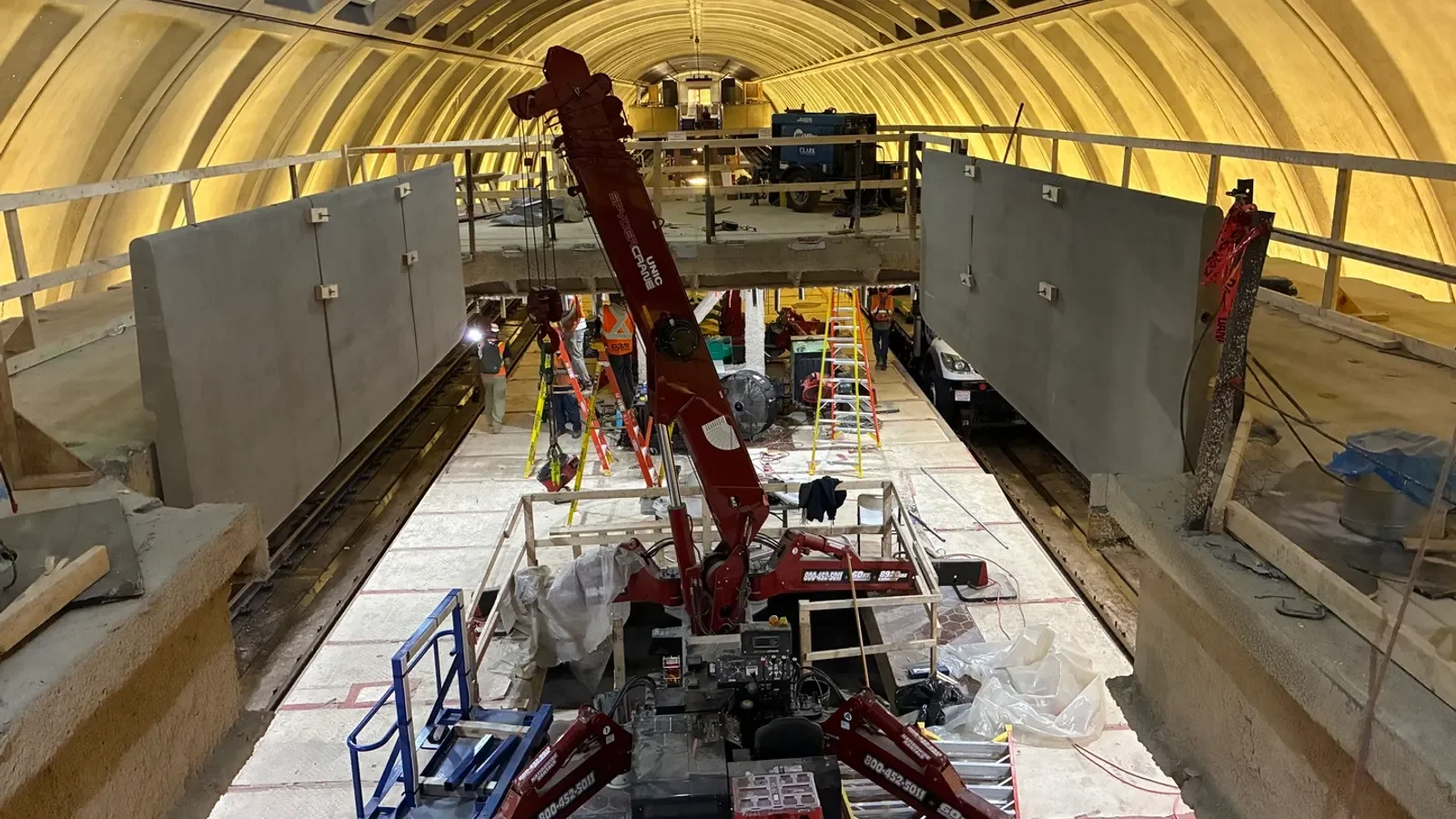
The work sequence hinged on the location of the rope anchor points beneath the sidewalk: crews had to remove the walkway before replacing the suspenders, then restore it afterward. That dependency helps explain why this was more than a surface renovation. The pedestrian route had to be taken apart to reach structural components below it, and then rebuilt as part of the same job. Work on an active bridge also brings a constraint familiar from major infrastructure projects: construction has to fit around the facility's continuing use.
Skanska’s senior vice president of operations, David Murawski, said the team developed hoisting systems and temporary platforms suspended from the bridge’s main cable to reach work areas while keeping normal traffic moving. The approach points to the planning required when access is difficult and closures need to be managed. Temporary platforms and lifting systems can provide workers with a way to reach constrained areas, but they also add equipment and sequencing to a job already dependent on the order of construction. Keeping traffic moving was part of the stated plan, not a minor side issue.
Skanska expects to remain on site for several more months to remove temporary conduit and carry out additional electrical work. So the reopening marks the return of the pedestrian route, but not the end of every task associated with the project. That distinction is common in construction: a public-facing milestone can arrive before all temporary works and supporting systems have been cleared. The remaining work is narrower in description than the rope replacement and pathway rebuild, but it still has to be completed before the site activity winds down.
Three projects remain in the program
Two other phases are underway: rehabilitation of the Center Avenue and Lemoine Avenue bridges, and work on the George Washington Bridge’s lower-level steel and movable maintenance platforms. These projects cover different components and locations, which makes the restoration program less like one continuous job than a series of linked efforts. The South Walk reopening is prominent because people can see and use the result directly; work on steel or maintenance platforms may be less visible while still addressing the bridge’s operating infrastructure.
Completed work elsewhere in the program includes replacing roadway finger joints and 32 deck panels at the bridge’s two towers. Crews also rehabilitated pavement on the upper-level eastbound roadway and ramps at 178th and 179th streets this year. Taken together, the listed work spans pedestrian facilities, roadway surfaces, structural connections and maintenance access. It gives a sense of the program’s breadth, though the source doesn't provide a condition assessment for each component or a measure of how much useful life any individual repair is expected to add.
What the remaining work means
The final planned phase covers components of six bridges over the Trans-Manhattan Expressway: Fort Washington Avenue, Broadway, Wadsworth Avenue, St. Nicholas Avenue, Audubon Avenue and Amsterdam Avenue. With eight projects complete, the reopened South Walk marks a visible step in a long-running effort to renew the bridge and its surrounding connections. The sequence also shows why a program can remain active even after a major public route has reopened: separate structures and systems require separate work, and progress on one doesn't finish the others.
This is more significant than it looks. A pedestrian route depends on structural elements, safe approaches and workable connections at both ends; the reopening brings those pieces together in a way people can assess for themselves. If you're working in this space, the practical lesson is that public access and construction logistics have to be considered together from the start. (And this is the part most people overlook.) A bridge can carry traffic through a construction period while still requiring careful limits on who can use a particular walkway.
Eight completed projects is a clear milestone against an 11-project plan, but it isn't a measure of the program's final effect. The remaining phases will determine how the broader set of bridge and roadway connections comes together. The numbers here are underwhelming as a finish line: three projects remain, and Skanska still expects several months of work at the South Walk site. A reopened path, at last.